Issued: 15 April 2025
12 mins read
We are Queensland’s environmental regulator. The Frontline series takes you inside our work to assess environmental risks, hold polluters to account and deliver enforcement actions and outcomes. You’ll meet our people, learn about what they do, and what drives them in what can be a challenging and complex role.
South-east Queensland’s first cyclone in 50 years meant a massive preparation and recovery effort – and we were part of it.
On 24 February 2025, as Cyclone Alfred began tracking down the coast, more than four million South-east Queensland residents were on alert.
And just like residents, emergency services and local councils, we were watching, listening, preparing and acting.
Our goal during high-risk weather situations is to work with industries and businesses to be ‘pollution-prepared’ for the potential impacts of flooding, storms and high winds.
In this Frontline series article, we take a look at the hidden pollution risks of high-risk weather, such as Cyclone Alfred and how we work with operators to prepare and what happens when things go wrong.
Our role in high-risk weather
Extreme, wild weather can impact community safety and the environment – among those impacts, can be the risk of pollution.
As Queensland’s environmental regulator, it’s our role to work with industry and businesses to make sure they are prepared and have contingencies in place to prevent, minimise and respond to pollution.
Preparation for high-risk weather is a legal requirement of the Environmental Protection Act 1994. We can take enforcement action when this obligation is not met.
Hidden risks of floods, rain, cyclones and drought
We regulate different types of businesses in many sectors, from aquaculture, food processors, metal producers, and timber and sugar mills, to chemical manufacturers, mines, waste transport, and landfill, recycling, sewage treatment and waste management operators (to name a few).
Extreme weather events, be they deluges or droughts, can present significant environmental risks if businesses are not prepared.
Floods can wash pollutants and sediment from sewage infrastructure and industrial and construction sites, carrying chemicals, fuels and hazardous materials into waterways.
Containment systems at waste treatment plants, landfills, composting and recycling facilities can also be at risk of inundation and the release of pollutants into the local environment.
Droughts can expose the earth and erode without vegetative cover, leading to dust storms and air quality issues. These conditions can also result in fire risks for example in stockpiled waste or materials.
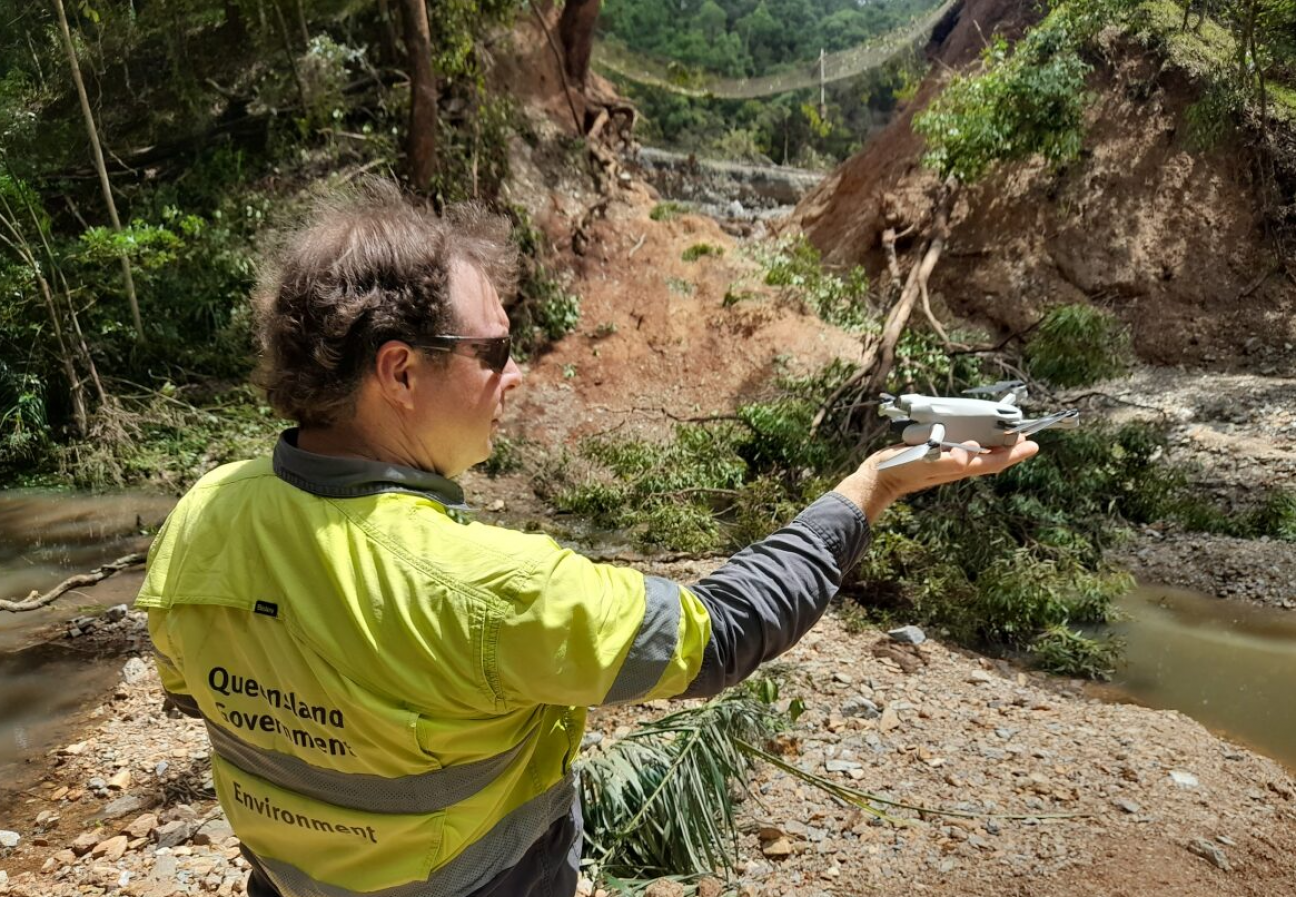
In Alfred’s wake, Compliance Officer Matt sends up a drone to complete an aerial check of a bund wall collapse (pictured in the background) in the Mt Gravatt area to assess risk and downstream impacts.
Be prepared to prevent pollution
Being prepared for the potential pollution impacts from high-risk weather can look like any number of things.
Examples include making sure water is managed on site (for unexpected overflow during flooding or for dust suppression during long spells of dry weather), that stockpiles of different materials are managed (to prevent fire risks) and making sure erosion and sediment controls are in place and maintained. Some sites also may need to ensure adequate pumping capacity and emergency power is installed.
It can also include making sure disaster management plans are current and there are mechanisms to keep the local community informed (particularly for dust risks).
No matter what the industry, business or high-risk weather situation, the key to a quick recovery and preventing pollution, is preparation and implementation of emergency plans.
An operator who recognises the risks, installs measures and is ready to initiate emergency mitigation measures is able to recover quicker, return to normal operations faster, ensure staff remain employed and minimise impacts to the environment and community.
We provide operators with a range of resources and information to help them prepare for the unexpected.
During the past 10 years, the number of high-risk weather situations has also been increasing – and we, like Queensland business, industry and community – are always learning and adapting our response.
Our Compliance Teams also undertake annual, proactive pre-wet or seasonal preparedness inspection programs at high-risk sites across the state. These inspections are informed by weather predictions and focus on site preparedness.
For example, our pre-wet season inspections across the state during September to December 2024 included assessment of stormwater controls and runoff storage capacity, sediment and erosion control, embankment stability, chemical storage and flood risk potential.
Our staff also participate in District Disaster Management Groups with other disaster response agencies.

One of our Gold Coast Compliance Team assesses coastal impact in order to understand challenges and work required to support recovery.
What did we do as Alfred tracked closer?
We issue a licence, called an Environmental Authority (EA), which sets out the conditions that businesses must comply with.
EA conditions typically cover a range of environmental management and protection areas to ensure operations minimise harm to the environment and community health.
Sometimes, unforeseen circumstances mean that these conditions cannot be met - such as high-risk, extreme weather in an unusual location.
As Cyclone Alfred tracked closer to the coast we knew there would be operators who may be affected by things like flooding, high winds, infrastructure damage or power outages and would not be able to meet the conditions of their EA – that’s when our assessment teams swung into action to ensure our emergency licencing process provided flexibility to industry while minimising industrial impacts to the environment.
Assessment Manager Rebecca said there are two types of emergency, temporary licences that can be issued when operators are not able to meet the environmental obligations outlined in their EA.
“The first is a Temporary Authority (TA) which permits operators to carry out activities that they’re not usually licenced for.
“The second, and more common, is a Temporary Emission Licence (TEL).
“A TEL gives permission for a particular duration of time, usually so an operator can carry out short-term releases of emissions (or pollutants) that are otherwise not permitted. This could include release of contaminated water to a flooded waterway or allowing a waste transfer facility to operate outside business hours, which may not usually be permitted due to local noise limits in the local area.
“We did pre-lodgement preparation and refresher training so our team could assess TA and TEL applications quickly.
“We also contacted EA holders who we knew were likely to be impacted to make sure they understood their obligations, what pathways were available for them to manage issues and, if necessary, make an emergency licence application,” Rebecca said.
We publish TA and TELs to our Public Register Portal.
Boots on the ground response

After Alfred, our Compliance Officers were on site at waste management facilities to assess flooding impacts. These sites were also receiving higher volumes of waste while in recovery mode, which made situations challenging.
While our assessment teams were preparing for the licencing process, our compliance teams on the ground were also making preparations.
The role of compliance teams is exactly as it sounds – they work with operators on the ground to ensure they are complying with the conditions of their environmental licence (be it their usual EA or an emergency, temporary licence such as a temporary authority or TEL).
They are out on site, visiting operators and working with them to assess and mitigate issues across a wide range of situations and industries.
Compliance Delivery Manager Matt said teams took advantage of Alfred’s long lead-in time to establish their own resilience, ensure business continuity, placement of equipment and vehicles, and stand-up a staff on-call roster to respond to emerging issues.
“Compliance officers had access to mapping tools for cyclone tracking, rainfall, flood mapping and stream gauging stations to forward plan and identify which sites were most at risk of flooding. We then communicated with operators in the forecast track map to discuss preparation,” Matt said.
“This preparation meant our compliance officers had a prioritised list of potentially impacted operators to communicate with and as Alfred moved across the coast, we continued communicating with operators to evaluate impact and the potential for harm.”

Officers at a fuel refinery in response to reports of a crude oil spill. Side note for the photography buffs, the blue hue in the photograph is due to using photographic gear that does not present a risk of sparking.
What happens when things go wrong?
The unfortunate fact is things go wrong sometimes.
Flooding and heavy rainfall can mean things like sewage infrastructure can be compromised, or landfill, composting and mining facilities flood.
Contaminants can pollute surrounding environments.
Operators are legally obligated to prepare and if the worst happens notify us when pollution happens.
In these instances, our compliance officers conduct site visits and undertake impact assessment field-based work to evaluate the extent of environmental damage as a result of industrial pollution releases.
This work can include reviewing water quality monitoring, taking water and other samples from the local environment for analysis and reviewing satellite and drone imagery.
They consider the parameters in an emergency licence (the TA or a TEL) and the situation at hand, as well as whether the operator has done what they reasonably could. We may consider taking action where operators don’t meet their obligations.
During Alfred, compliance teams were out on site attending a variety of locations to discuss impacts, evaluate harm and consider regulatory options to assist and expedite recovery.
“We also had extensive consultation with Local Governments about coastal impacts and recovery of the coastal zone to support tourism and restore natural processes, as well as with waste operators to accommodate the significant waste volumes that come from natural disasters,” he said.
Our people
During our response to Alfred, about 45 compliance officers were on the ground from Maryborough south to the Gold Coast and west to Ipswich. In addition, we had close to 50 assessment staff in our business centres assessing emergency waste, coastal and emission licences on top of their ordinary work and more staff were taking reports through our Pollution Hotline.
Most of them were juggling their own preparation, concern for their families and loved ones and, in some instances, damage to property.
Matt said preparing for unexpected weather disasters is challenging and requires investment and time.
“But in our experience that investment provides ongoing economic, social and environmental benefits for the whole community,” he said.
“Staff worked through weekends and out of hours to attend meetings, respond to reports of concerning environmental impact, formulate procedures and make regulatory decisions in support of industry.
“Our staff are highly committed to their work, supporting the community and protecting the environment through supportive regulatory solutions and options.
“During something like Alfred, I’m so proud to work alongside our team and I know that our work makes a difference. Our staff are compassionate about the challenges industry faces, keen to engage with operators to discuss their situation, and prepared to take action where operators make reckless decisions that puts the environment at risk,” Matt said.
What next?
In the lead-up to, during and after Cyclone Alfred, we issued 12 emergency licences in sectors including quarries, waste management, industrial processing and sewage treatment.
Once a temporary licence has been issued our compliance teams oversee progress and compliance. The role of these teams is exactly as it sounds – they work with operators to ensure they are complying with the conditions of their temporary licence.
Just a couple of weeks after Alfred, western Queensland’s floods topped 1974 levels and towns were evacuated.
Southeast Queensland received more heavy rainfall.
North Queensland, still recovering from record flooding earlier in the year, was also hit with more flash flooding.
Our assessment and compliance teams across all regions continue to be a part of preparation and recovery efforts – working to support industry and protect our environment and local communities from pollution.
Stay up-to-date
For our latest news and where to subscribe, like and follow us, visit our News and media page, which will connect you with our social media accounts, media releases, Down to Earth blog and newsletter and other helpful resources and information, from right across our department.