Issued: 20 February
8 mins read
We are Queensland’s environmental regulator. The Frontline series takes you inside our work to assess environmental risks, hold polluters to account and deliver enforcement actions and outcomes. You’ll meet our people, learn about what they do, and what drives them in what can be a challenging and complex role.
Queensland is no stranger to wild weather.
But it gets particularly wild in our central and northern regions, which can face everything from cyclones, intense rainfall and flooding to high winds, drought and bushfires.
For communities, local councils, industry and businesses, these weather events can be catastrophic and result in massive preparation and recovery efforts – and we are part of it.
In this Frontline series article, we look at how we work with north and central Queensland councils, industries and businesses to prepare for possible pollution risks before the clouds roll in and flood waters rise, and what we do when wild weather strikes.
A wild wet season
The first few months of Queensland’s 2025–2026 wet season were relentless.
During December 2025, Queensland’s far north, north and north west regions were hit by multiple weather events - tropical winds, heavy rain and a monsoonal trough. Disaster assistance was triggered for these regions.
By 10 January 2026, the first cyclone of the season formed off Townsville in north Queensland. Tropical Cyclone Koji reached its peak as a Category 2 system and made landfall between Ayr and Bowen. It weakened into a tropical low and brought heavy and intense rainfall as it tracked inland to the Gulf Country (more than 300mm fell in just six hours for some areas of central Queensland and Clermont recorded its wettest 24 hours in more than 100 years with more than 200mm falling).
This tropical low delivered more rain to an already heavily saturated catchment, trigging devastating flooding. Stock losses were estimated to hit more than 100,000, communities were isolated, homes evacuated, farms destroyed and millions of dollars of flood disaster support were announced.
As Queensland’s environmental regulator, our role during high-risk weather events like these is to work with industries and businesses to make sure they have contingencies in place to prevent, minimise and respond to pollution.
Preparation is key to preventing pollution
In the lead up to the 2025-2026 Queensland wet season, our north and central Queensland Compliance Teams, based in Cairns, Townsville, Mackay, Rockhampton, Gladstone and Maryborough undertook the annual, proactive pre-wet season preparedness inspection program at key sites including mines, refineries and waste facilities.
The purpose of the inspection is exactly as they sound - to focus on site preparedness for high rainfall and flooding. The inspections are informed by weather predictions and level of risk at the site. They are conducted by specialist staff who are experienced in a wide range of industries.
In addition to inspections, we also have a range of resources to assist industry prepare. These include briefings, online information and resources, webinars and proactive risk assessment for water inventories.
What type of pollution can occur?
Across north and central Queensland, we regulate more than 5000 Environmental Authorities (EA) in many sectors, from mining, refineries, power stations and timber and sugar mills, to chemical manufacturers, sewage treatment and waste management operator
An Environmental Authority (EA) is a licence which sets out the conditions that regulated sites must comply with. EA conditions typically cover a range of environmental management and protection requirements to minimise harm to the environment and community health. Failure to comply with EA conditions can result in enforcement action.
Given the frequency of heavy rainfall, flooding and cyclones, a key focus for our northern and central Queensland teams is the management of water and waste at regulated sites and assisting local councils return disrupted services (such as water, sewage and waste disposal facilities) to full operation. In these cases, pollution can happen if infrastructure is damaged or there is an operational disruption due to a power outage.
Industries such as mining and fuel storage facilities are among those that can inadvertently cause pollution during floods - if containment systems fail, hazardous substances may be released.
Mining operations also risk their waste storage dams overflowing.
In the case of mines, the quality of excess water captured in storage facilities or a pit will deteriorate over time. Mine water releases are permitted to allow operators to responsibly and proactively manage water accumulated on-site during periods of high rainfall. The increased natural water flows associated with heavy rainfall can help minimise potential environmental impacts.
With high rainfall and flash flooding we also expect sporadic fish kills from natural variations in environmental conditions. When this happens, we work alongside local councils and water service providers to investigate whether pollution is suspected to have been one of the causes.
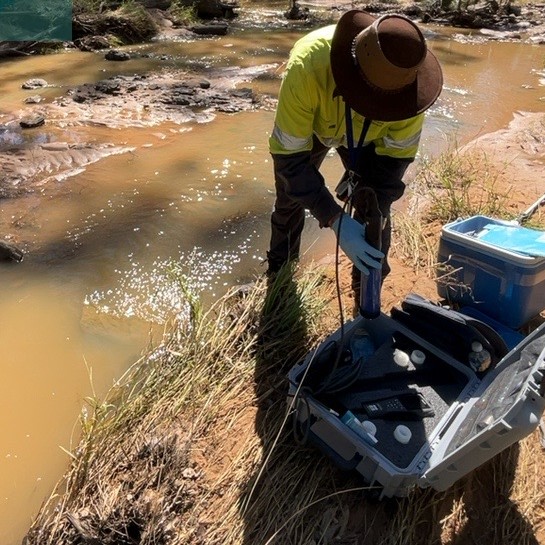
On-site conducting water sampling, which helps us assess environmental impacts.
If something significant occurs at a regulated site, our officers work with operators to mitigate harm and limit legacy impacts. On some occasions, we may visit the site to conduct visual assessments, and monitor water and soil to assess impacts on the local environment.
Following ex-Tropical Cyclone Koji, we worked with high-risk sites to address specific issues due to large volumes of water from the intense rainfall.
We also maintained daily reporting for the Fitzroy Coal Mine Water Release webpage to keep the community informed about mine water releases and we engaged with mine operators to ensure released water was effectively diluted to minimise impacts downstream.
Senior Environmental Officer Tammy works in the Mackay Compliance team and was part of the ex-Tropical Cyclone Koji response.
Tammy said in the wake of the cyclone, the team conducted site inspections and engaged with industry to assess operational impacts and environmental risk.
“During these inspections we also consider the resilience of response systems to ensure they remain relevant and appropriate for future severe weather events.
“We know from experience in previous high-risk weather situations and particularly during our wet season, that if sites are well-prepared and have their high-risk weather contingencies in place, they tend to manage better during events like we’ve experienced.”

One of the central region team in the field assessing Tropical Cyclone Koji flooding impacts at a site in the Mackay area.
Supporting response and recovery
Flooding and cyclones can devastate north and central Queensland industries and communities. We provide critical support to help businesses and councils recover while maintaining compliance with environmental laws.
There are three key actions we can take to support response and recovery efforts:
- Issue a Temporary Emissions Licence (TEL) to provide temporary flexibility to EA conditions.
- Make waste disposal easier for disaster-affected communities.
- 24-7 incident response services.
Temporary Emissions Licence (TEL) – a TEL gives a site operator temporary flexibility during extreme events for some of their licence conditions that are otherwise not permitted by their EA.
In the wake of ex-Tropical Cyclone Koji, we issued a number of TELs to support sites manage water and introduce temporary measures to facilitate a return to normal business operations. TELs are assessed within 24 hours of receipt and often require our teams to work outside of business hours.
Making waste disposal easier – in some local council areas a waste levy fee applies for disposing waste into landfill. The levy encourages recycling, reduces environmental impact and funds programs that encourage sustainable waste management.
Under the Waste Reduction and Recycling Act 2011, waste generated through a state-declared disaster is exempt from the waste levy, regardless of the type of waste. This exemption reduces the financial burden of clean-up and recovery for councils, businesses, and households.
For example, following Tropical Cyclone Koji, six local councils in the Townsville, Mackay and Rockhampton areas were granted waste levy exemptions. These exemptions meant councils could dispose of flood-damaged items such as furniture, appliances, carpets, fallen trees, damaged stock, and even hazardous waste like asbestos. By easing the financial strain, we ensure recovery efforts can proceed more efficiently.
24-7 incident support – we maintain a 24-hour, seven day a week incident response service to respond to incidents outside of business hours. This service is maintained during extreme weather events and includes providing advice or assisting with response with agencies such as the Queensland Fire Department and Queensland Police.
Protecting ecosystems all year round
North and central Queensland’s ecosystems are culturally significant, iconic and environmentally important - they include the Great Barrier Reef, Daintree Rainforest, Wet Tropics World Heritage Area and Gulf Savannah. They are vital for biodiversity and our economy. Our role as the environmental regulator is crucial to protect these natural assets.
Our teams in these regions are no strangers to extreme weather events. All year round they are assessing how operations may be affected by different weather scenarios and what impacts need to be managed. This is done as part of environmental assessments of a new activity, evaluating a site’s management practice during a routine site inspection or identifying learnings as part of a follow-up with a site after a weather event or incident.
We use learnings from each event to improve our approach and encourage operators to look at ways to build reliance to adapt for future events.
Through monitoring data collected during these weather events, we also track the long-term effects of floods on water quality and ecosystem health. This data informs our regulatory decisions and helps industries adapt to changing environmental conditions. For example, we look at cumulative impacts of water releases across catchments to ensure best practice management of releases as well as informing strategies to improve readiness for future events.
Making a difference when it counts
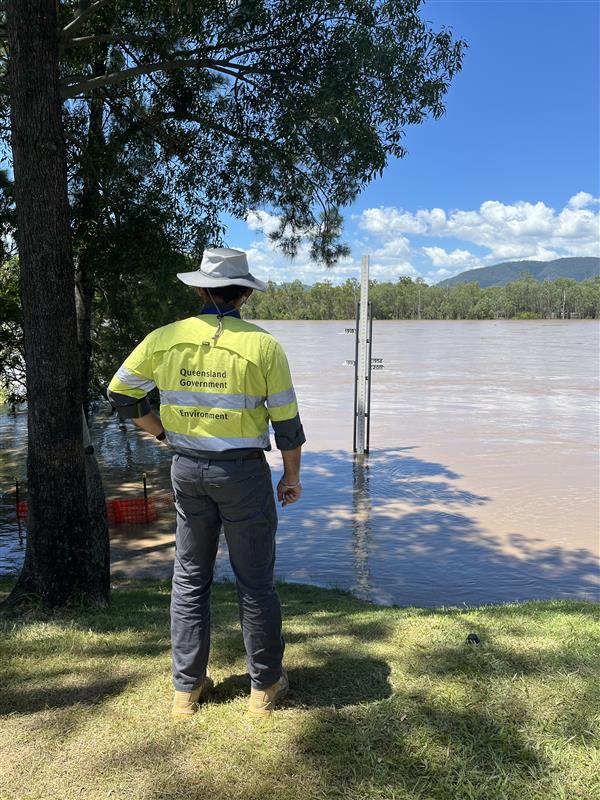
Rockhampton officers were out regularly monitoring the Fitzroy River flood gauges, working with the local council and emergency services in the wake of ex-Tropical Cyclone Koji.
Team Leader Isobel works with Tammy in the Mackay office. She said the team’s priority is to ensure sites are able to recover from these types of weather events while also focusing on environmental outcomes.
“Weather events like what we’ve been experiencing really highlight our essential role in protecting ecosystems, supporting industries and ensuring compliance with environmental laws.
“From monitoring pollution risks to granting waste levy exemptions, TELs and overseeing ecosystem restoration, we are committed to helping our community recover and build resilience against future extreme weather events,” she said.
“For me personally, this is some of the most exciting work we do - we utilise our expertise to act quickly, make informed decisions and collaborate with industry to make a difference when it counts.”
Further reading
Learn how we worked to prevent and address pollution during 2025’s Tropical Cyclone Alfred.
Learn more about our high-risk weather preparation, resources available for business and industry, manuals, statutory responsibilities and our webinar series.
Read more Queensland Regulation Insider stories and our media releases.
Stay up-to-date
For our latest news and where to subscribe, like and follow us, visit our News and media page, which will connect you with our social media accounts, media releases, Down to Earth blog and newsletter and other helpful resources and information, from right across our department.