Every now and then, a case lands on our desks that feels more like a movie plot than a standard regulatory job.
This one has it all: a hobbyist with a metal detector; a sharp-eyed community member browsing the web for hidden gems, and a collection of artefacts that haven't seen the light of day since 1799.
We recently had the privilege of handing over some very rare items to the Queensland Museum. What could easily have been mistaken for scrap metal was in fact a significant archaeological find linked to the earliest period of European coastal exploration in Queensland.
So how did we, Queensland’s environmental regulator, end up putting the pieces of this unusual puzzle together? What exactly is our role when it comes to saving artefacts that tie into Queensland’s history? Read on to find out what happened.
What’s our role when it comes to historical artefacts?
When people think of our department – the Department of the Environment, Tourism, Science and Innovation (DETSI) – they might think of National Parks and wildlife. But (among many other things) we are also responsible for enforcing the Queensland Heritage Act 1992. The Heritage Act provides the legal framework to protect, conserve and manage culturally significant places and items. It ensures Queensland’s rich history is preserved for future generations while balancing development with conservation.
This isn't just about old buildings. It's about protecting the history of Queensland, which includes the items and places that tell us who we are and where we came from. Administering and enforcing the Act involves various responsibilities, including:
- assessing sites for the Queensland Heritage Register
- reviewing land-use proposals that might impact heritage sites
- ensuring compliance with conditions placed on those sites (this is where our compliance officers come in)
- investigating the unauthorised removal, sale or damage of archaeological artefacts
- taking enforcement action (like issuing penalties) when necessary.
In short, our job involves protecting Queensland’s cultural identity, so history isn’t lost but saved for everyone to learn from.
What was found on Bribie Island?
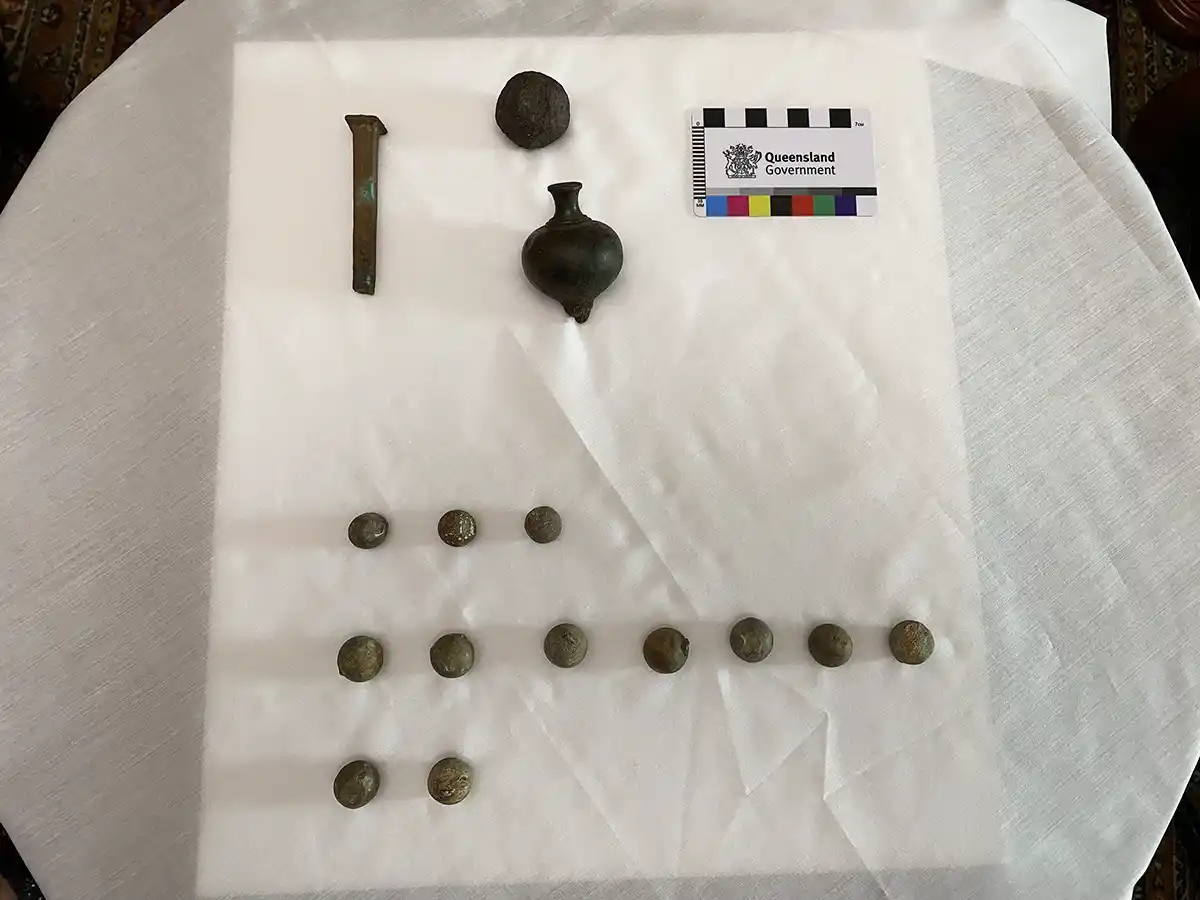
It all started with a metal detector enthusiast visiting the beaches and surrounds on Bribie Island, uncovering several peculiar items over a number of years. The collection of items included:
- a hand-wrought nail with a four-sided shank used for construction and repairing boats
- a plumb bob: a pointed weight that would be attached to a string that is used to find a vertical reference line
- 48 small lead shot musket balls – drop made or mould made
- decahedron metal ball potentially used as a ship’s ballast.
Eventually, the enthusiast placed the artifacts for sale on online.
 Open larger image
Some of the items found on Bribie Island, from top left in a clockwise direction, a hand-wrought nail, a decahedron metal ball, a plum bob and musket balls.
How did we get involved?
This case didn't start with a field inspection; it started with a tip-off. A member of the public noticed these specific items listed for sale and reported them to us as items that had possible historical significance.
Once we received the report, our compliance officers started investigating. Their first step was to take a closer look at the listing and follow up with the seller. Our officers visited the seller and examined the items in question.
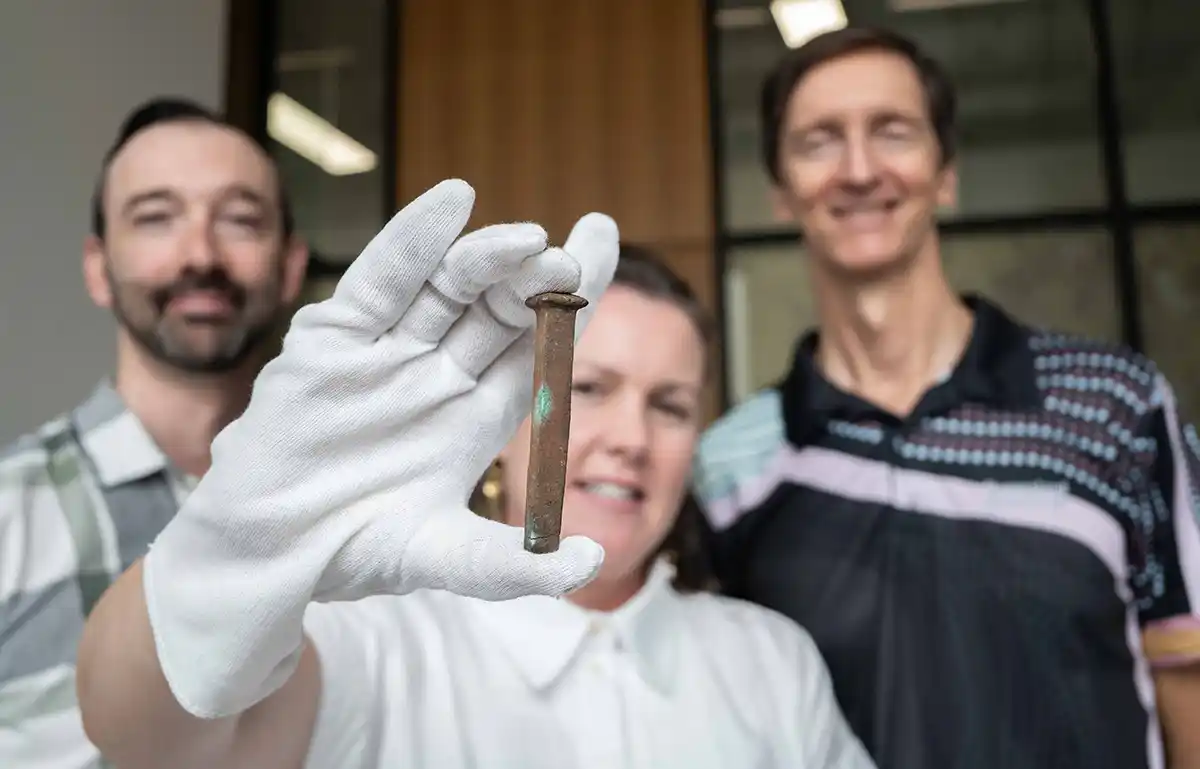
Brisbane-Moreton Compliance Officers Daniel and Sasha were our officers who took on the case and identified that the items may hold historical value.
“Several artefacts stood out as likely being of historical importance,” Daniel said. “Under the Queensland Heritage Act 1992 we have the authority to seize items so our archaeology experts in our Heritage branch can make further assessments.”
Sasha said it was definitely the most unusual and interesting case she had been involved in.
“Our work is usually a lot different to this,” she said. “I found it fascinating to be involved in a case under the Heritage Act and have learnt so much about our history, the work of our archaeology experts, landholders and the Queensland Museum.”
 Open larger image
Compliance officers Daniel, from left, Sasha and Simon who were involved in the investigation. Sasha is holding one of the artefacts found – a nail with a four-sided shank that was used for construction and repairing boats.
What is the historical significance of the items?
It became clear that the items were highly likely to have originated from the late 18th to mid-19th century, consistent with morphology of items from that period.
Based on notes recorded by Captain Matthew Flinders, the items may have been in his possession in July 1799.
As the first British explorer to enter Moreton Bay, Flinders spent two weeks in the area on his boat the HM sloop Norfolk.
On 16 July 1799, the Flinders crew is believed to have fired a musket at Skirmish Point and then left behind a shot belt containing musket balls.
According to his notes, Flinders was also at White Patch on 23 July 1799.
DETSI Cultural Heritage Coordinator Dr Anthony Simmons said the artefacts could be associated with the incidents recorded in Flinders’ notes.
“The musket balls and maritime artefacts could be physical evidence of historical events, and it is important that they be preserved,” he said.
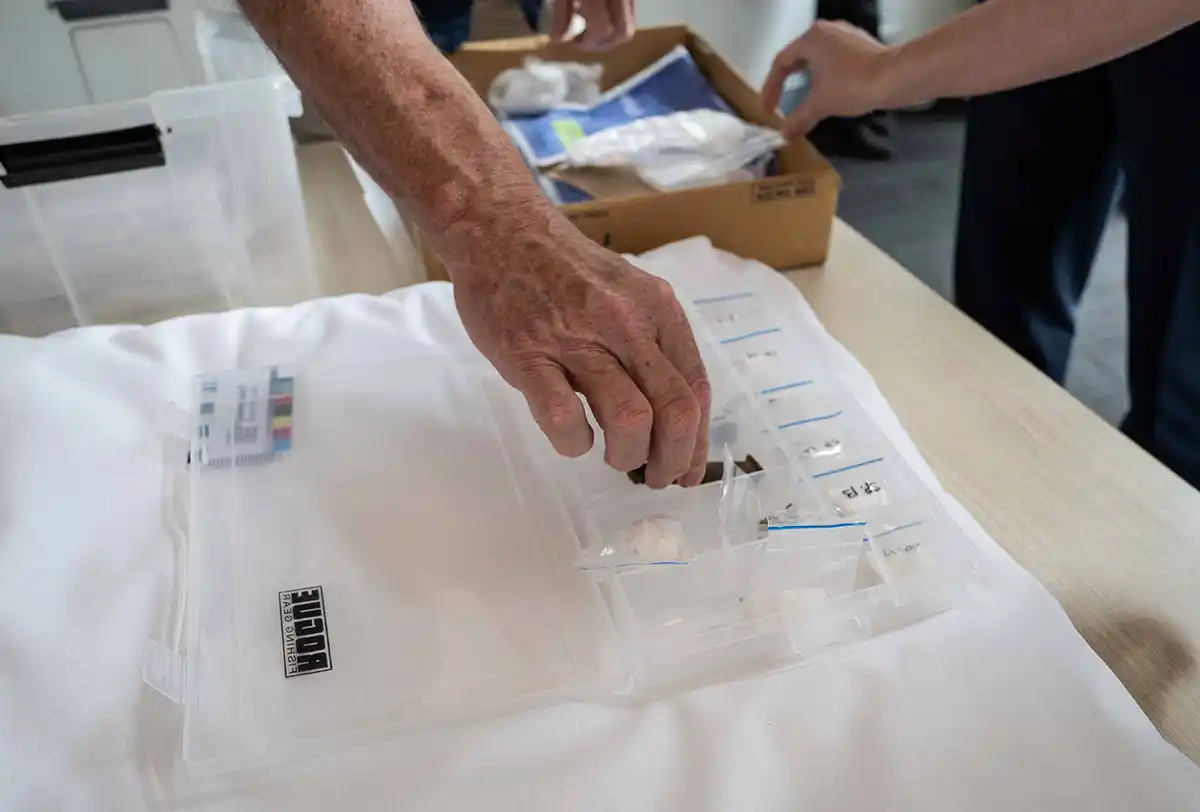
Once the team confirmed the historical significance of the artefacts, the items were then handed over to the Queensland Museum so they could be safely kept longer-term.
 Open larger image
Representatives from the Queensland Museum joined us to mark the end of the investigation and accept the artefacts into their collection.
Why the old saying ‘finders keepers’ doesn’t always apply
This case serves as a reminder that ‘finders keepers’ is not a legal principle in Queensland when it comes to archaeological and historically significant artefacts. Whether you find an artefact in your backyard or on a beach, the Queensland Heritage Act 1992 protects items of cultural significance.
Under the Heritage Act, people must report any discovery of significant archaeological artefacts to DETSI and should not move them from where they are found. Artefacts shouldn’t be moved so heritage officers and archaeologists can study its surrounding environment, including its location, depth, position and relationship to other objects or features. This context can provide important clues about the artefact's age, origin, use and cultural significance.
If you stumble across something that looks like a piece of history, the best move is to report it, so it can be properly analysed and preserved.
Collaboration secures Queensland's past
The Bribie Island artefacts case demonstrates the strength of Queensland’s approach to heritage protection and the collaboration it can take to ensure items of significance find their way into museum collections.
In this case, the person who discovered the artefacts was unaware of their obligations under the Heritage Act and moved them from where they were found. They were later reminded of the correct process, which is to report discoveries and leave them undisturbed until they can be assessed by experts.
Fortunately, despite the artefacts being moved in this instance, archaeologists were still able to gather enough information to determine their historical significance and better understand their story. However, preserving an artefact in its original location always gives experts the best opportunity to accurately interpret and protect Queensland's heritage.
Thanks to a community member reporting a suspicious sale, along with the work of our compliance officers and heritage team, museum professionals, public stakeholders and landowners, these artefacts are now safely housed at the Queensland Museum.
This unusual case shows how collaboration, vigilance, and dedication can help preserve Queensland’s past for its future. Who knew a curious beach visitor could connect us to Captain Matthew Flinders and a treasure trove of history?
It may not quite be buried treasure, but thanks to everyone involved, it’s no longer hidden.
Stay up-to-date
For our latest news and where to subscribe, like and follow us, visit our News and media page, which will connect you with our social media accounts, media releases, Down to Earth blog and newsletter and other helpful resources and information, from right across our department.