Issued: 15 April 2025
9 mins read
We are Queensland’s environmental regulator. Our case studies take you on a deep dive into our work. They explore our role and responsibilities, how our assessment, compliance and investigations unfold to protect our environment and communities, and how legislation, evidence, science and expertise informs our work.
Until you read a headline about a sewage spill, you probably don’t give sewage treatment much thought (which is understandable).
The thing is, it’s a fascinating sector, at the forefront of many environmental, technological, scientific and societal challenges.
Our job is to regulate sewage treatment plants and sewage pumping stations. We make sure utility providers – who release an estimated 290 gigalitres of treated sewage to coastal waterways each year – are meeting their environmental obligations to protect our environment and prioritise community health and safety.
In this case study, we look at how we regulate sewage treatment in Queensland and how we reached the Albert River sewage spill enforcement decision, what it means and what happens next.

Brenda was among the team of scientists who gathered water, plant, sediment and animal samples to determine potential impacts to local ecosystems of the Albert River sewage spill.
What happened?
In September 2024, we reached one of Queensland’s largest environmental enforcement decisions after our investigation into the impact of the Albert River sewage spill.
We launched the investigation into the cause and extent of environmental harm after more than 450 million litres of sewage spilled into the Albert River between January and April 2024 following the failure of a City of Gold Coast pipe in Yatala.
Following our investigation, the City of Gold Coast Council agreed to a $2.3 million enforceable undertaking.
An enforceable undertaking (EU) is an enforcement tool under the Environmental Protection Act 1994 (the Act) that sets out actions that must be carried out to remedy any environmental harm, prevent further occurrences and to secure compliance with the Act and enhance the protection of the environment. (We explore this enforcement tool in more detail further on in this case study.)
Key requirements of the Albert River enforceable undertaking include:
- a project costing more than $1 million to design and implement an enhanced sewer network monitoring project that will significantly reduce the risk of future sewage spills
- a $1.1 million project to remove weeds and plant native vegetation at August Burow Park at Alberton that will improve the condition of the wetlands, improve water quality, provide better habitat connectivity and improve the biodiversity and resilience of the ecosystem
- a $120,000 project to remove weeds and plant native vegetation at Halls Road Nature Reserve, Luscombe
- the provision of high value scientific data to DETSI and industry
- substantial improvements to infrastructure management systems and processes including condition assessments of all high-risk infrastructure.
What is our role in sewage treatment?
Key takeaways
- We issue a licence, called an Environmental Authority (EA), which sets out the conditions that sewage treatment and pump station operators must comply with.
- EA conditions typically cover a range of environmental management and protection areas to ensure operations minimise harm to the environment and community health.
- Failure to comply with EA conditions can result in enforcement actions such as orders, fines and/or prosecution.
- All EAs issued in Queensland are published on our Public Register Portal.
Sewage treatment – a crash course
Before learning about our role in sewage treatment, here is a super quick summary of what sewage treatment involves.
There are two key elements – the sewage treatment plant operations (including infrastructure) and its by-products.
Sewage pumping stations are used to transport wastewater from homes, businesses and factories to sewage treatment plants.
Sewage treatment plants use physical, chemical and biological processes to remove contaminants and produce two key by-products:
- treated effluent (treated liquid waste) that is safe for release into the environment (land, rivers, the sea or re-use if it meets strict criteria set on the EA), and
- biosolids (treated solids) which can be treated further to meet strict criteria for re-use as products such as soil conditioner or fertiliser in agriculture, forestry and land rehabilitation.
Our role
We play a critical role in regulating how sewage treatment plants and pumping stations operate to make sure their impact on local environments is minimised, waterways are kept safe and public health is protected.
Science is an important part of our role – our scientists are often among the teams responding to incidents and complaints to ensure research, data and expert advice inform our decision-making and response.
Sewage treatment is classed as an Environmentally Relevant Activity (ERA) (specifically ERA 63) under the Environmental Protection Regulation 2019.
An ERA is an activity that has the potential to impact the environment and therefore requires regulation to manage and minimise its environmental risks. ERAs cover a wide range of industrial, agricultural and waste management activities and sectors. An ERA is assessed based on its scale and potential environmental impact.
Once we complete this assessment and it is determined the activity is suitable and is approved, sewage pumping stations and treatment plants are then issued with an EA to be able to operate.
An EA is a licence (or permit) we grant that sets out the conditions required to lawfully operate. Conditions typically cover a range of environmental management and protection areas to ensure operations minimise harm to the environment and community health. When assessing and developing an EA, multiple laws, regulations, codes and guidelines can apply.
Key conditions of a sewage treatment plant EA can include:
- effluent quality and discharge limits
- monitoring and reporting requirements
- waste management guidelines about how to dispose of or reuse the waste products including sludge and biosolids that are generated during the treatment process
- environmental management plans that describe how potential environmental impacts will be managed, including odour control, noise reduction and managing risks to land, water and air
- incident management protocols for responding to incidents or emergencies such as unintended releases or treatment failures
- infrastructure and maintenance, and
- site specific conditions.
We work with EA holders to ensure they meet their EA conditions through assessment of compliance with the EA, monitoring and enforcement, research and policy development and public consultation and education.
Read the EA (permit number EPVX01812014) issued to Gold Coast City Council which sets out the conditions for operating sewage pumping stations.

Plant, animal, sediment, and water sampling was conducted to determine the impact of the sewage spill.
How did we reach the Albert River enforcement decision?
Key takeaways
- Council reported the spill as required by their EA.
- We liaised with Council who notified stakeholders and the community of the issue so that they were able to take action to prevent exposure.
- We collected data and evidence which was then used to inform our enforcement decisions.
In April 2024, we became aware of the Albert River sewage spill when the City of Gold Coast Council notified us of a spill, as required by their EA. Our science division’s Aquatic Ecosystem Health team, who undertake data collection for the Healthy Land and Water Ecosystem Health Monitoring Program had identified a decrease in dissolved oxygen and increase in ammonia concentrations in the Albert River but the source was unknown.
Our next steps involved discussions with Council, risk assessments, site inspections, engagement with local stakeholders such as local fishers, waterway users and other government agencies including Queensland Health, Food Safety Queensland and the Department of Primary Industries.
Signage was erected closing waterways to fishing and the Council, as the polluter, also had an obligation to be communicating with the community about the issue. Given the scale of the spill, public interest and impacts, we also published a web page and a media release to provide updates about the spill and our investigation.
The aim during this stage of the process was to quickly alert key stakeholders and the community to the issue, while we investigated and gathered evidence to determine the level of pollution and impacts on the environment and community safety to ensure the Albert River was safe to use.
Scientists from our Science Division’s Investigations and water quality monitoring teams developed a sampling plan and spent four days gathering water, plant, sediment and animal samples to determine impacts to local ecosystems. The team went out in boats, walked riverbanks and mangroves and used fishing lines and nets to ensure a comprehensive range of data across species, times of day and tidal times were collected.
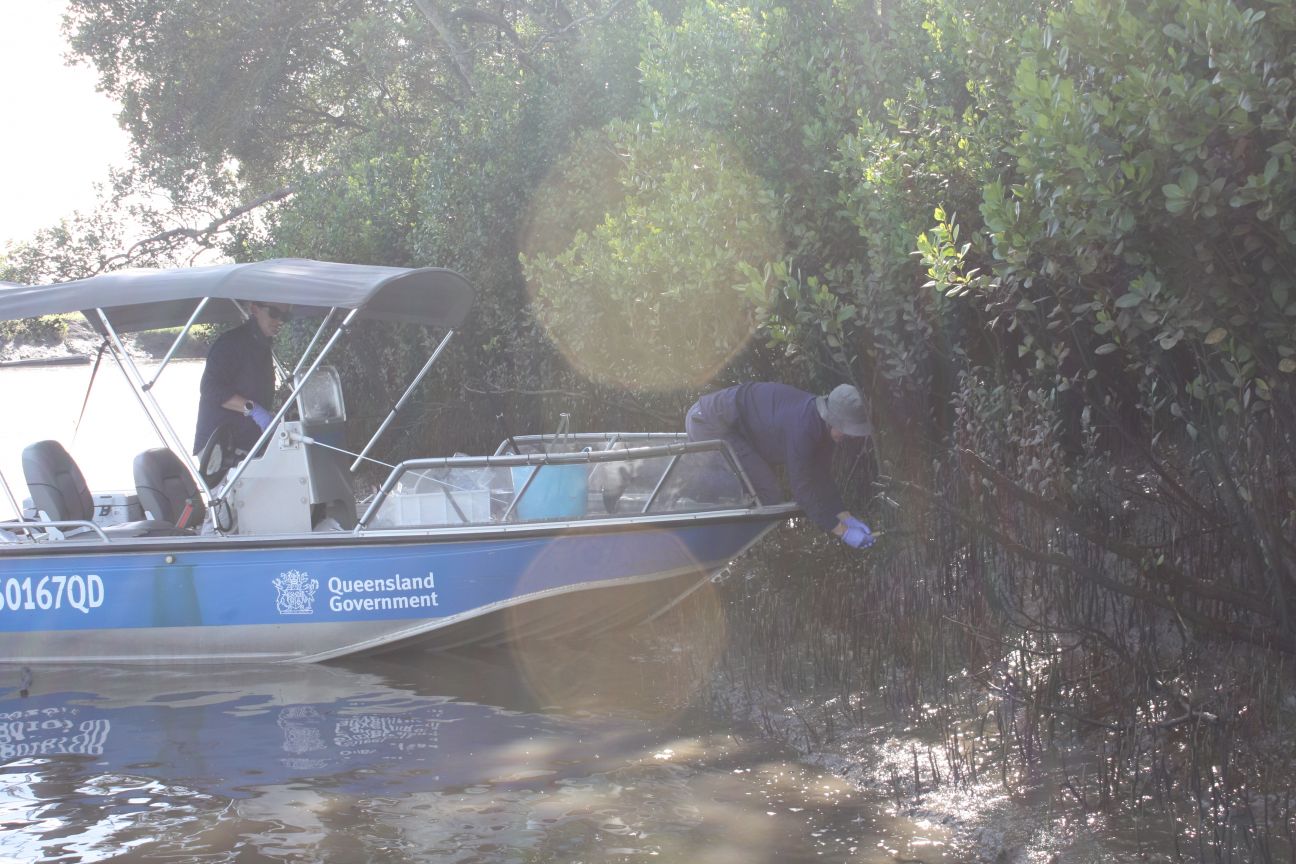
Multiple sites were visited to conduct sampling.
Once our samples were analysed at laboratories, the results came back to our Science Investigations team, who reviewed the data, along with information from other sources including waterway flow and water quality data from gauging stations in the river. Using multiple sources of information gave us an evidence-based, comparative picture of the ecosystem’s health before and after the spill and the potential scope of impact.
This evidence is an important part of our work, and together with our site investigations – which included reviewing our satellite and drone imagery, photographic and video evidence, witness statements and council’s site documentation – all coming together to form our investigation.

Cast nets were used to collect different species of fish. This type of sampling gives us an evidence-based, comparative picture of the ecosystem’s health before and after the spill and the potential scope of impact.
Then we considered whether a prosecution was an appropriate enforcement response in accordance with our Enforcement Guidelines or if we should consider a different enforcement response, such as an enforceable undertaking.
At all times our officers and decision-makers are guided by our governing legislation, regulation, codes, guidelines, data and other evidence.
At the heart of this decision-making was a focus on public interest and environmental protection, in terms of addressing the situation and ensuring there was a plan of action that safeguarded against future risks and any factors that might cause a similar spill.
What is an enforceable undertaking?
Key takeaways
- An enforceable undertaking (EU) sets out actions that must be carried out to remedy environmental harm, prevent further occurrences and to secure compliance with the Act.
- We use EUs to ensure ratepayer monies remain in the local community rather than being diverted into the costs of a prosecution.
- All EUs issued in Queensland are published on our Public Register Portal.
An enforceable undertaking is an enforcement tool under the the Act that sets out actions that must be carried out to remedy any environmental harm, prevent further occurrences and to secure compliance with the Act and enhance the protection of the environment.
The EU for the Albert River sewage spill, requires Council to carry out environmental restoration works across the Albert and Logan River estuaries, as well as vital improvements to its aging sewerage infrastructure including enhanced leak detection systems and monitoring of the network.
When considering appropriate enforcement action, we determined the community would be best served by ensuring ratepayer monies remained in the local community rather than Council bearing the costs of a prosecution.
To decide which locations would benefit from an EU, council put forward a proposal. We assessed this proposal through research, drone and satellite mapping imagery and environmental considerations regarding factors like riparian ecology, habitat connectivity, wildlife corridors and sensitive ecological areas to decide where the best environmental outcomes can be achieved.
All EUs we issue are published online at our Public Register Portal.
Read the EU we issued on 27 September 2024 for the Albert River sewage spill.
To learn more about an EUs read our guideline.
What happens next?
Key takeaways
- The Albert River sewage spill investigation is now closed, but we continue to monitor council’s compliance with the enforceable undertaking.
- Strong penalties can apply if council fails to comply with the requirements of the enforceable undertaking.
The Albert River sewage spill investigation is now closed, but we continue to monitor council’s compliance with the EU.
We do this by developing a plan of action in collaboration with the council. In this plan, council sets out how it intends to meet the requirements of the EU. The plan also covers why and how the spill happened and proposes recommendations about how they will prevent it from happening again. In this case – as is the case with many sewage spills – aging infrastructure is a key challenge.
Our compliance team undertakes ongoing checks to determine the EU requirements are being met. Our sciences team also continues to undertake regular water quality monitoring of local waterways.
Further reading
- Our Albert River sewage spill investigation page
- Learn more about how wastewater is treated and managed
- Learn more about our compliance and enforcement work
Stay up-to-date
For our latest news and where to subscribe, like and follow us, visit our News and media page, which will connect you with our social media accounts, media releases, Down to Earth blog and newsletter and other helpful resources and information, from right across our department.