Coal seam gas
 Open larger image
How coal seam gas is produced
Coal seam gas (CSG) is a natural gas, consisting primarily of methane, which is found in coal deposits.
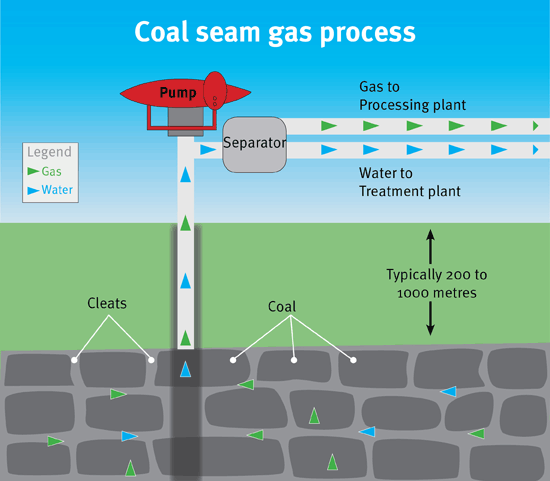
Coal seam gas collects in the coal seams by bonding to the surface of coal particles. The coal seams are generally filled with water, and it is the pressure of the water that keeps the gas as a thin film on the surface of the coal.
CSG is extracted through wells drilled into coal seams. The initial phase of CSG production usually involves the extraction of water from the coal seams in order to reduce the pressure and release gas from the coal.
If the pressure within the seam is high, the gas may flow to the surface unaided. Conversely, the gas may have to be pumped to the surface if the pressure is lower.
When CSG comes to the surface, water in the gas is separated.
The water is then treated to ensure it meets water quality standards, before it is injected into underground water systems, called aquifers, used for other purposes such as irrigating crops, watering livestock or for commercial use, for water supplies or added to watercourses.
CSG in use
CSG is used safely to power Queensland homes.
It is used in the same ways as natural gas including fuelling natural gas appliances, such as heaters and stoves, and generating electricity.
Electricity generated from CSG is a cleaner energy source as it produces around half the emissions of electricity generated by coal.
LNG industry
LNG is simply CSG that has been cooled to minus 161°C so it becomes a liquid, reducing it to 1/600 of its original size so it is able to be transported safely and economically to Queensland’s export markets.
Queensland’s CSG reserves will provide the basis for the developing LNG industry which will become one of the state’s major exports.
Read more about the gas industry.
Legislative requirements
Petroleum and gas activities are regulated under the Environmental Protection Act 1994 and an environmental authority is required before any petroleum activity can commence. The environmental authority imposes conditions to reduce or avoid potential environmental impacts associated with the petroleum industry. For more information on the legislative requirements associated with petroleum activities see:
Other legislation may offer specific protection to areas with the potential to be impacted by conventional and unconventional gas or oil exploration, such as the Regional Planning Interests Regulation 2014 offers protection to the Lake Eyre Basin rivers and floodplains.
Environmental considerations
Environmental considerations include:
- groundwater impacts and aquifer interconnectivity from hydraulic fracturing
- impacts to land from production activities and accidental spills
- environmental nuisance from noise, dust, light and odour.
Condamine Alluvium CSG Area
The Environmental Protection Act 1994 (EP Act) prescribes some conditions that must be complied with by operators of certain activities. These ‘deemed conditions’ apply in addition to any conditions imposed through an environmental authority (EA) for the activity and do not need to be explicitly stated as a condition on an individual EA, as it will apply automatically.
On 29 June 2026, amendments to the EP Act commenced which introduced a deemed condition for coal seam gas (CSG) activities in the prescribed Condamine Alluvium CSG area.
The Condamine Alluvium CSG area is defined as an area that:
- includes all or part of the aquifer known as the Condamine Alluvium
- is shown as the Condamine Alluvium CSG area on a map approved by regulation and published on the Department of State Development, Infrastructure and Planning's website.
The deemed condition requires resource companies to ensure water quality remains consistent with the established water quality objectives for the region.
The deemed condition operates by reference to existing water quality objectives. Where local data is available, water quality objectives may be tailored and set as site specific objectives within individual EAs to ensure the protection of water quality in the area.
The deemed condition applies to new EAs issued for CSG activities in the Condamine Alluvium CSG area which includes EAs issued via a standard, variation or site-specific application process.
The deemed condition does not apply to:
- wells authorised under an existing EA prior to commencement
- wells authorised under an existing EA after the commencement, where the activity was the subject of an amendment application submitted but not decided before commencement
- wells authorised under a new EA, where the application for the EA was submitted but not decided before commencement.