Issued: 27 February
4 mins read
We are Queensland’s environmental regulator. Our Education series is designed to inform, educate and provide practical insights about key topics that underpin our work across Queensland.
Clean up Australia Day on 1 March is a national day-of-action for legends against litter.
Once the gloves are off and your local event has finished, you can join our legion of legends who report pollution, littering and illegal dumping all-year round to our Pollution Hotline and our online Littering and Illegal Dumping Form, or their local council.
In Queensland, during the 2024–25 financial year, 13,107 tonnes of litter and illegally dumped waste were cleaned up by local councils at an estimated cost of $20.0 million – that’s the equivalent to 1211 garbage truck loads.
It’s a massive problem.
And we’re part of the collective effort to address it and protect our environment.
Our role as Queensland’s environmental regulator is critical – we tackle pollution, litter and illegal dumping in four ways.
1. Community reports
You can report pollution incidents to us by calling our 24/7 Pollution Hotline on 1300 130 372, make a report online or send an email to pollutionhotline@detsi.qld.gov.au.
You can report littering and illegal dumping to us through our Litter and Illegal Dumping Online Reporting System
We know Queenslanders are concerned about pollution, litter and illegal dumping – we receive thousands of reports each year.
During the 2024-25 financial year, our Pollution Hotline received almost 18,000 community reports and we received 3256 online reports through our Littering and Illegal Dumping reporting form.
Reports can prove critical to our compliance and investigative work. They can help us track down who was responsible and can lead to fines or prosecution in the courts.
2. Our compliance and investigations work tracks down offenders to deliver fines, clean up orders and prosecution in the courts.
During the 2024–25 financial year, we issued over $580,000 in infringement notices for littering and illegal dumping across the State.
Current infringement notices can range from $333 to $12,517.
Penalties issued by the courts can range from $5007 to $834,500.
Recent enforcement actions have tackled illegal dumping of tyres and household waste on the Gold Coast and Pimpama.
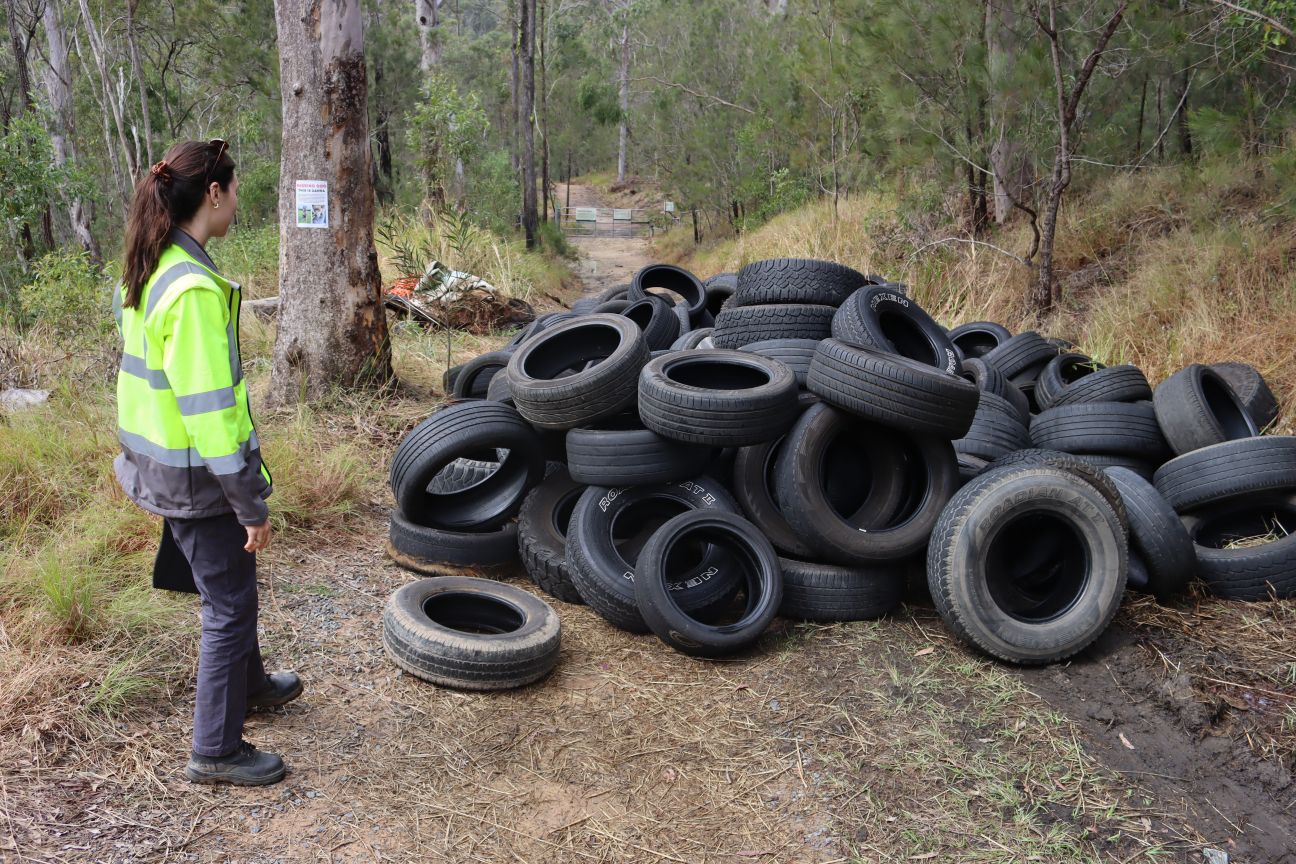
One of our compliance team surveys some of the 500 illegally dumped tyres in Springbrook National Park in August 2025
3. We provide funding to local governments and community groups to give them the resources they need to prevent, respond to and investigate littering and illegal dumping in their community.
Our $35 million Zero Litter to the Bay Program will provide funding to eligible south east Queensland councils to install filtration devices on major stormwater drains to prevent plastics and litter larger than 5mm from entering the iconic Moreton Bay. Applications are currently open for councils until 31 March 2026.
The $17.7 million Fighting Illegal Dumping Partnership Program (FIDPP) will fund councils to employ illegal dumping compliance officers, purchase surveillance equipment and compliance signage. Since the program started in 2020, our council partners have investigated more than 42,000 cases, issued more than 2500 fines to the value of $4.5 million and removed more than 80 million litres (333,000 wheelie bins) of illegally dumped waste from the environment.
We also fund the EcoMarines, an amazing not-for-profit environmental education provider working with schools and learning centres across Queensland. The EcoMarines are avid supporters of Clean up Australia Day and work all-year round to inspire action that protects the environment and raises awareness about sustainability.
We are also proud to partner with First Nations communities across Queensland as part of the Queensland Indigenous Land and Sea Ranger Program. The program assists First Nations organisations to employ Land and Sea Rangers and offers grant funding, training, networking and partnership support. Among a long list of achievements, is their ongoing clean up efforts across our coastlines which remove marine debris and safeguard habitats vital to marine life.
4. We make sure we have the right policy and legislation in place that can influence behaviour change through education, deter behaviour through regulation and penalties, and inspire innovation and alternatives through sustainable waste management practices and options.
We oversee the two key pieces of legislation for waste, recycling and environmental regulation in Queensland – the Waste Reduction and Recycling Act 2011 and the Environmental Protection Act 1994 – and a number of related policies, frameworks and guidelines.
We are responsible for making changes that ensure the laws remain relevant, effective and responsive to evolving needs and circumstances.
When significant changes occur, we often consult industry, stakeholders and community.
This is important because it ensures decisions, policies and legislation are informed, inclusive, and effective. Engaging with stakeholders, experts, and the community provides valuable insights, builds trust, and helps achieve better outcomes.
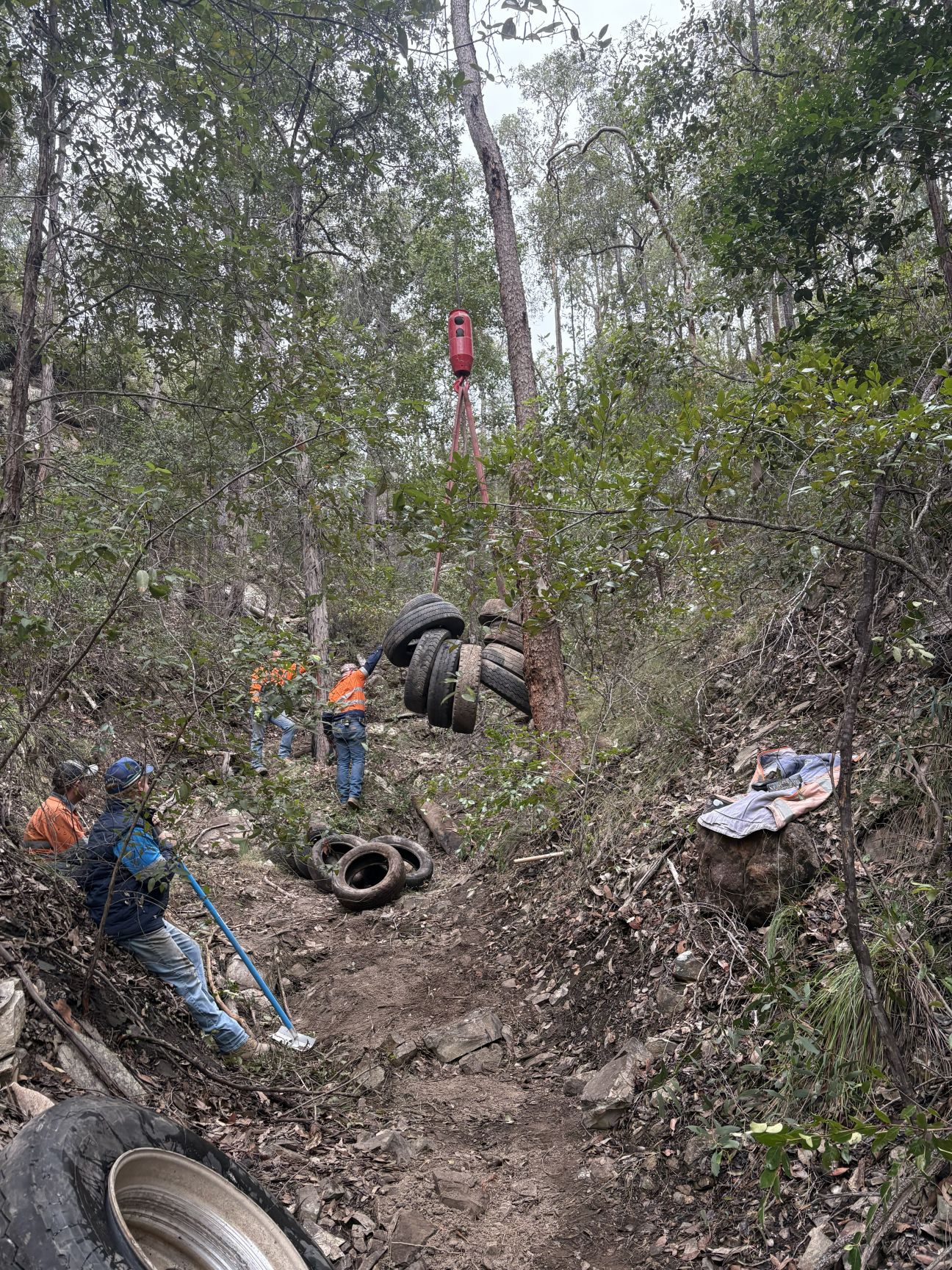
Removing 200 tyres from Isla Gorge National Park, southwest of Rockhampton in June 2025. It took a 130 tonne crane to remove the tyres from a deep ravine.
Why is it a problem?
Pollution, littering and illegal dumping affects our waterways, damages ecosystems and endangers wildlife. It can create health risks, attract pests and degrade the beauty of public spaces. Additionally, clean-up efforts cost millions of taxpayer dollars annually.
What type of things are littered and dumped?
Cigarette butts, old tyres, furniture, food packaging, whitegoods, appliances, bricks, concrete, asbestos sheeting and insulation materials, shopping trolleys, cars, boats and hazardous waste like chemicals, oils and fuel containers – the list could go on.
Sometimes, people think it isn’t littering – like dumping clothing outside charity stores, leaving furniture on the footpath hoping someone will take it, or throwing food waste out the window of cars. All of these things are littering. Remember – do the right thing and get it in the bin! Or use Recycle Mate to find the nearest location to take items for re-use, recycling or proper disposal.
Take action, learn more
- See it, report it, stop it - littering and illegal dumping reports can be made through our Litter and Illegal Dumping Online Reporting System.
- Report pollution incidents by calling the 24/7 Pollution Hotline on 1300 130 372, make a report online or send an email to pollutionhotline@detsi.qld.gov.au
- Learn more about the latest waste policy and legislation changes.
- Read about the fines we issued for illegal dumping in Beerburrum State Forest and at Pimpama on the Gold Coast.
- Contact your local council to learn more about litter and illegal dumping programs in your area.
- Search Recycle Mate to find the nearest location to take your unwanted items for re-use, recycling or proper disposal.
- Participate in the annual Clean up Australia Day on 1 March.
- Learn more about the EcoMarines.
- Learn more about the Indigenous Land and Sea Ranger program.
- Learn more about our funding programs Fighting Illegal Dumping Partnership Program (FIDPP) and Zero Litter to the Bay Program.
Stay up-to-date
For our latest news and where to subscribe, like and follow us, visit our News and media page, which will connect you with our social media accounts, media releases, Down to Earth blog and newsletter and other helpful resources and information, from right across our department.